Double Time Calculator
Enter your hourly rate and the hours you worked in one day, set where overtime and double time start, and see the pay for each tier.
Recent
Your last 10 settings, saved only in this browser. Nothing is uploaded.
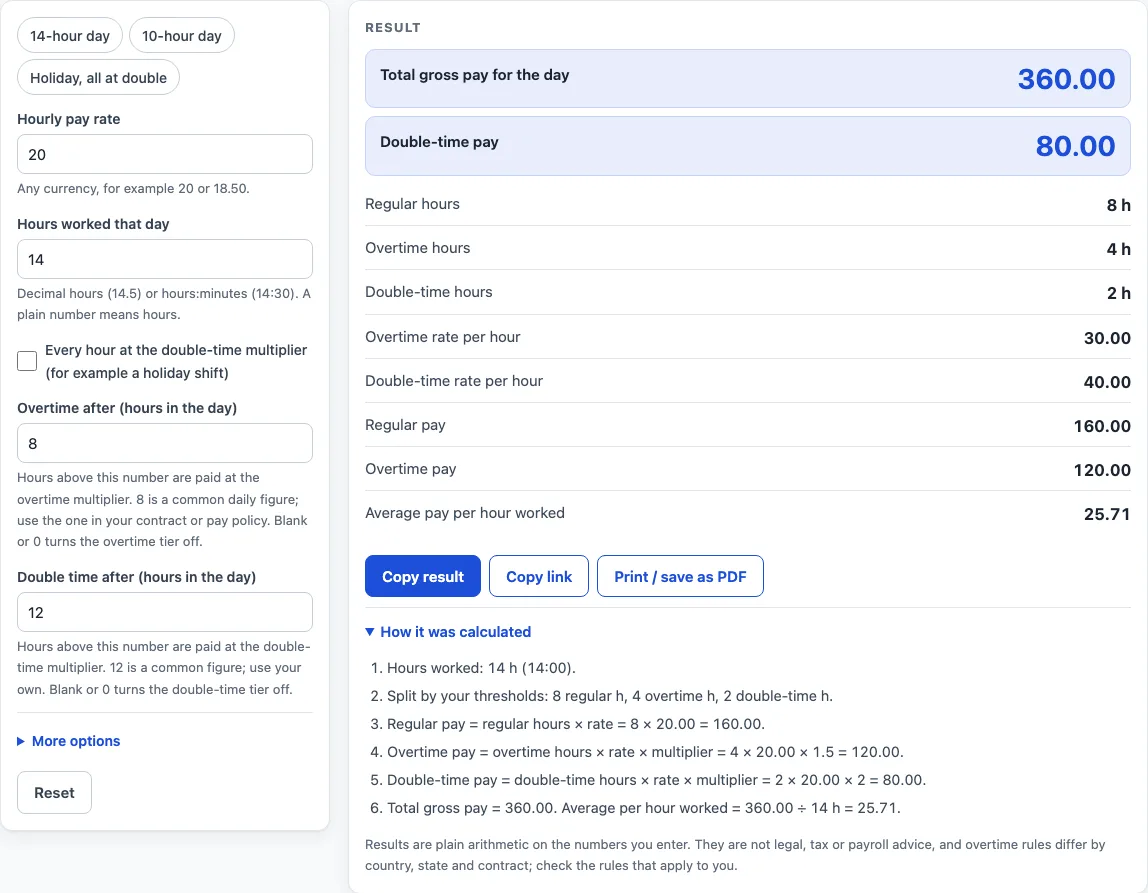
How to use the Double Time Calculator
- Type your hourly rate into the rate field.
- Enter the hours worked that day. You can use a decimal (7.5) or h:mm (7:30). The maximum is 24.
- Set overtime after (default 8 hours) and double time after (default 12 hours). Enter 0 or leave a field blank to switch that tier off.
- Check the overtime multiplier (default 1.5) and the double-time multiplier (default 2). If you cannot see an input, open More options.
- Read the results: regular, overtime and double-time hours, the overtime and double-time hourly rates, the pay for each tier, total gross pay for the day, and average pay per hour worked.
- Open How it was calculated under the result to see each formula with your own values.
- Read any warning shown above the result before you rely on the figure.
The preset buttons above the form load three typical cases: a 14-hour day, a 10-hour day, and a holiday with every hour at double time over 8 hours. Reset brings back the starting example.
To test a different arrangement, change either threshold or either multiplier and watch the pay for each tier update. Setting a threshold to 0 or leaving it blank switches that tier off, and the tick box makes every hour use the double-time multiplier.
How do you calculate double time?
Double time pays each hour beyond a set point at twice the regular hourly rate. You find the hours past that point, then multiply them by the rate and the double-time multiplier, which is 2 by default. The point itself comes from your contract or employer policy, not from any general rule.
Most people work out double time in three parts. First, count the hours up to the overtime threshold; these are paid at the rate. Second, count the hours between the overtime and double-time thresholds; these are paid at rate × overtime multiplier. Third, count the hours above the double-time threshold; these are paid at rate × double-time multiplier. The U.S. Department of Labor’s overtime page describes a different rule: at least 1.5 times the regular rate for hours over 40 in a workweek under the Fair Labor Standards Act, for covered, non-exempt employees. This calculator uses that 1.5 figure only as an editable default.
How do you calculate double time pay?
Double-time pay is the double-time hours multiplied by the double-time hourly rate. Add it to the overtime and regular pay to get the total gross pay for the day. The basic arithmetic is hours × rate × multiplier, summed across the tiers.
For example, a worker paid 20 per hour who works 12 hours, with overtime after 8 and double time after 12, has 8 regular hours, 4 overtime hours and no double-time hours (the double-time threshold is 12, so the hours above it are zero). Double-time pay is 0 in that case. If the same worker works 14 hours, the 2 hours above 12 are paid at 40 per hour, giving 80 of double-time pay. The average pay per hour worked is the total gross pay divided by the hours worked, so it falls between the lowest and highest rate that applies.
Worked examples
| Input | Result |
|---|---|
| 14 h at 20/h, overtime after 8 h, double after 12 h | 2 double-time h, gross pay 360.00 |
| 10 h at 20/h, overtime after 8 h, double after 12 h | 0 double-time h, gross pay 220.00 |
| 8 h at 18/h, every hour at double time | 8 double-time h, gross pay 288.00 |
| 14 h at 20/h, overtime after 8 h, double after 12 h | 2 double-time h, gross pay 400.00 |
Calculated by the tool above; open it with the same values to see each step.
Frequently asked questions
What does the warning about a multiplier above 2 mean?
Multipliers can be any value of 1 or more, so you can test a triple-time case by entering 3. Values above 2 trigger a warning to check your contract, because rates that high are unusual and should match what your agreement says.
Can I pay every hour at double time?
Yes. Tick Every hour at the double-time multiplier to pay all hours at rate × double-time multiplier and ignore both thresholds. This suits a holiday shift that your contract pays at double time from the first hour.
Is the double time calculator free, and is anything I type uploaded?
Yes, it is free and needs no account or sign-up. Everything is calculated in your browser, and nothing you type is uploaded.
Can I print or share a calculation?
Yes. Print / save as PDF creates a one-page record with the inputs, results, calculation steps and the date. Copy link copies a page address that stores every input, so the same calculation can be reopened later or sent to someone else.
Is this tax or payroll advice?
No. Results are plain arithmetic on the numbers you enter, before any deduction. They are not legal, tax or payroll advice, and rules differ by country, state and contract.
Related tools
- Overtime Calculator: split a week’s hours into regular, overtime and double-time pay.
- Time and a Half Calculator: the time-and-a-half rate and the pay for overtime hours.
- Hourly Wage Calculator: gross pay per day, week, month and year from an hourly rate.
- Biweekly Pay Calculator: compare gross pay per paycheck for weekly, biweekly, semi-monthly and monthly pay.
- Time Card Calculator: total a week of clock-in and clock-out times, with breaks, rounding, overtime and pay.
- Shift Hours Calculator: end time and paid hours for 8, 10 and 12 hour shifts.