Work Hours Calculator
Enter when you start, when you finish and your unpaid break to see the hours you work per shift, week, month and year.
Recent
Your last 10 settings, saved only in this browser. Nothing is uploaded.
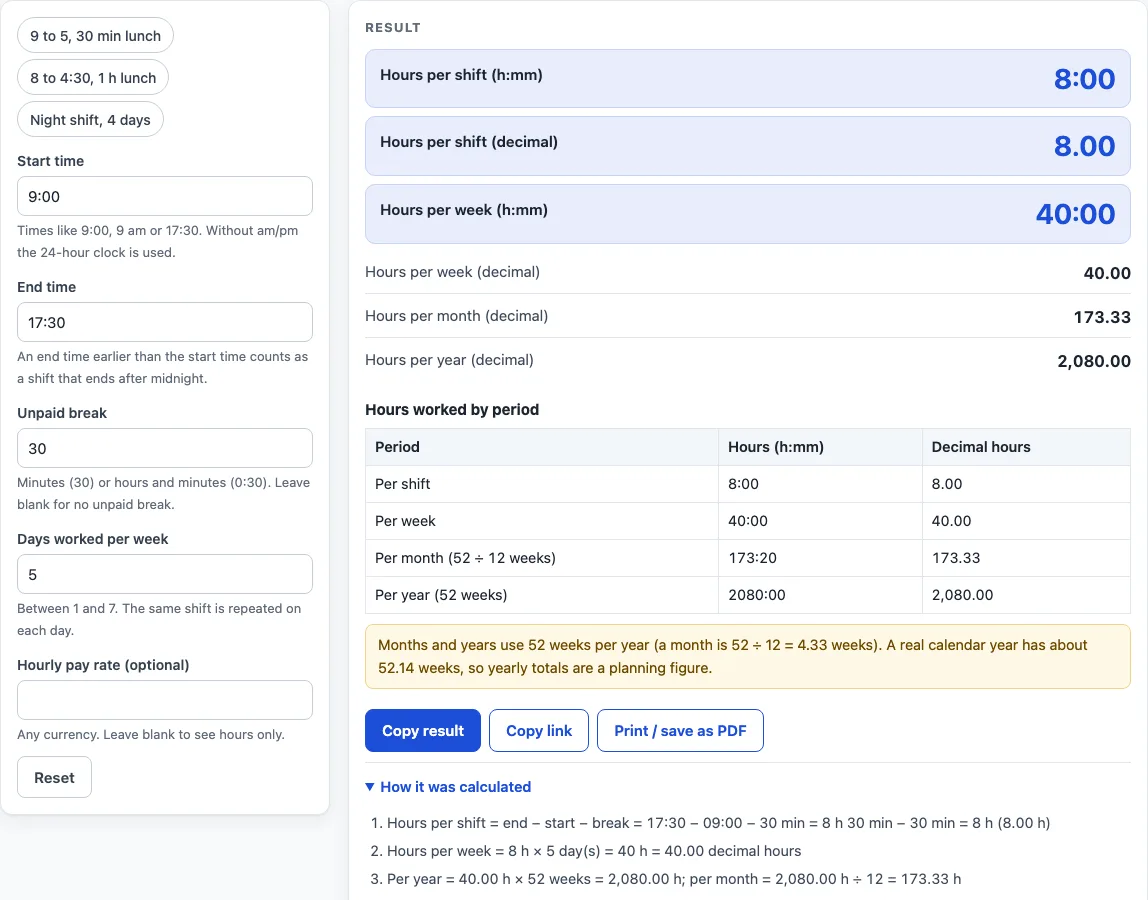
How to use the Work Hours Calculator
- Type your start time, for example 9:00 or 9 am.
- Type your end time, for example 17:30 or 5:30 pm. If it is earlier than the start time, the shift is counted as ending after midnight and a warning appears.
- Enter the unpaid break in minutes (30) or as hours and minutes (0:30). Leave it blank if you take no break.
- Set days worked per week to a number from 1 to 7. The default is 5.
- Optionally, enter an hourly pay rate to see gross pay per shift, week, month and year.
- Read the result, then open “How it was calculated” under it to see each step with your values.
To start from a typical case, press one of the preset buttons above the form: 9 to 5 with a 30 minute lunch, 8 to 4:30 with a 1 hour lunch, or a night shift. “Reset” returns to the starting example. “Copy link” stores every input in the page address, so the same calculation reopens later or can be sent to someone else. “Copy result” copies the result lines with a link, and “Print / save as PDF” prints a one-page record with the inputs, results, steps and date.
Gross pay, if you enter a rate, is hours times rate with no overtime added. The monthly figure uses 52 weeks divided by 12 months.
How to calculate hours worked
Hours per shift come from one subtraction: end time minus start time minus the unpaid break. For a 9:00 to 17:30 shift with a 30 minute break, the shift is 8:30 long and 8:30 minus 0:30 leaves 8:00, which is 8.00 hours in decimal form. A break is entered in minutes or as hours and minutes, and a blank break means zero. A break as long as the whole shift is rejected, and identical start and end times give an error, because in both cases no time is worked.
How to calculate hours worked per week, month and year
Multiply the hours per shift by the days per week to get hours per week: 8:00 × 5 = 40:00, or 40.00 decimal hours. Hours per year are hours per week multiplied by 52, so 40 × 52 = 2,080 hours. Hours per month are the yearly figure divided by 12, which is 173.33 hours. The 52-week year is a planning convention (52 × 7 = 364 days), while a real calendar year has about 52.14 weeks, so the yearly and monthly totals are estimates.
How to work out hours for an overnight shift
Times without am or pm use the 24-hour clock, so 9:00 pm is 21:00. A shift that crosses midnight would give a negative result if subtracted directly, so the calculator adds 24 hours when the end time is earlier than the start time and shows a warning. For 22:00 to 6:00 with a 30 minute break, the shift is 8:00 long and 7:30 is paid. A single shift longer than 16 hours also triggers a warning, so check the times if one appears unexpectedly.
How to turn hours and minutes into decimal hours
Decimal hours come from dividing minutes by 60: 30 minutes is 0.50 hours, so 7:30 is 7.50 hours. Gross pay is hours multiplied by the hourly rate, before any deduction, and it does not include overtime. Compare the result with your own records before relying on it for pay.
Worked examples
| Input | Result |
|---|---|
| 9:00 to 17:30, 30 min break, 5 day(s) a week | 8:00 (8.00 h) / 40:00 a week |
| 8:00 to 16:30, 1:00 min break, 5 day(s) a week | 7:30 (7.50 h) / 37:30 a week, gross 843.75 a week |
| 22:00 to 6:00, 30 min break, 4 day(s) a week | 7:30 (7.50 h) / 30:00 a week |
| 7:15 to 15:45, 45 min break, 6 day(s) a week | 7:45 (7.75 h) / 46:30 a week, gross 818.40 a week |
Calculated by the tool above; open it with the same values to see each step.
Frequently asked questions
What time formats can I type?
You can type 9:30, 9.30, 0930, 9:30 pm or 17:30. Without am or pm, the number is read on the 24-hour clock.
How does an overnight shift work?
If the end time is earlier than the start time, the calculator counts the shift as ending after midnight by adding 24 hours, and it shows a warning. For example, 22:00 to 6:00 with a 30 minute break gives 7:30 per shift.
Why does the calculator use 52 weeks a year?
It is a common planning convention, since 52 weeks × 7 days = 364 days, while a year has 365. Because a real calendar year has about 52.14 weeks, treat the yearly and monthly totals as estimates.
Why do I get a warning for a shift over 16 hours?
A single shift longer than 16 hours triggers a warning. Check the start time, end time and break you entered, since a long result often comes from a typo.
Is the work hours calculator free, and is anything I type uploaded?
Yes, it is free and needs no account or sign-up. Everything is calculated in your browser, and nothing you type is uploaded.
Can I print or share a calculation?
Yes. Print / save as PDF creates a one-page record with the inputs, results, calculation steps and the date. Copy link copies a page address that stores every input, so the same calculation can be reopened later or sent to someone else.
Is this tax or payroll advice?
No. Results are plain arithmetic on the numbers you enter, before any deduction. They are not legal, tax or payroll advice, and rules differ by country, state and contract.
Related tools
- Time Card Calculator: total a week of clock-in and clock-out times, with breaks, rounding, overtime and pay.
- Timesheet Calculator: add up any number of shifts pasted one per line.
- Biweekly Timesheet Calculator: a two-week time card with overtime counted per week.
- Time Clock Calculator: punches before and after lunch for each day of the week.
- Clock Out Time Calculator: find the time you can clock out.
- Weekly Hours Calculator: total the hours you worked on each day of the week.
- Printable Timesheet: print a blank weekly, biweekly, semi-monthly or monthly timesheet.
- Shift Hours Calculator: end time and paid hours for 8, 10 and 12 hour shifts.
- Time Clock Rounding Calculator: round punches to 5, 6, 10, 15, 30 or 60 minutes and see the effect.